

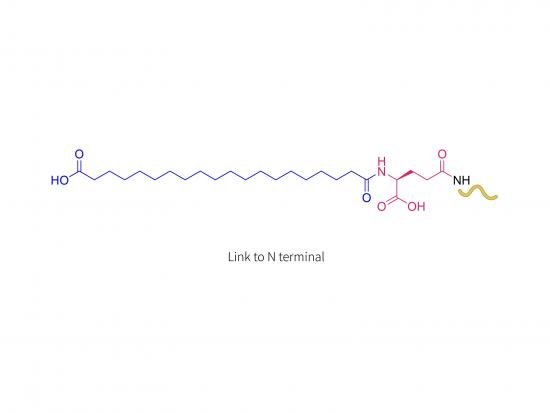
Cagrilintide(N-terminal) ,The N-terminal fragment of Cagrilintide is a peptide sequence derived from the N-terminal region of the full-length Cagrilintide, a long-acting amylin analogue for obesity and type 2 diabetes. This fragment contains key residues important for interaction with the amylin receptor complex (calcitonin receptor/CTR and RAMPs) and is often synthesized for research into receptor binding, structure-activity relationships, and analogue development. As a segment, it may retain partial receptor activity and is useful for elucidating binding mechanisms and for developing improved therapeutics.
Appearance
-
White to off-white solid powder or lyophilized solid
Source
-
Synthetically produced by solid-phase peptide synthesis (SPPS)
-
Not typically isolated from natural sources
Molecular Weight and Structure
-
Molecular weight: Depends on the specific fragment length and sequence; much lower than intact Cagrilintide (full-length: ~3917.9 Da)
-
Structure: Corresponds to the amino acid sequence from the N-terminus with a free amino (N-term) and carboxyl (C-term) group
Biological Activity
-
May bind the amylin receptor complex (CTR/RAMPs)
-
Activity dependent on fragment sequence, length, and post-translational modifications
-
Possible effects on gastric emptying, appetite regulation, and glucose metabolism, but likely less potent than full-length Cagrilintide
Purity and Microbial Contamination
| Purity and Microbial Contamination | Specification |
|---|---|
| Purity | ≥95% by HPLC |
| Microbial contamination | Minimal; confirmed by COA |
| Testing | Endotoxin testing (LAL assay), sterility |
Identity and Quality Control
| Identity and Quality Control | Specification |
|---|---|
| Mass Spectrometry (MS) | Confirms molecular weight |
| Amino Acid Analysis | Confirms composition |
| Peptide Sequencing | Confirms correct sequence |
| HPLC | Assesses purity |
| Optical Rotation (if chiral) | Enantiomeric purity verification |
Shelf Life and Storage
-
Shelf life: 1–2 years from manufacture; refer to COA
-
Store at -20°C or below, inert atmosphere (argon/nitrogen), tightly sealed, dry
-
Protect from light and avoid repeated freeze-thaw cycles
-
Lyophilized peptides are most stable
Applications
-
Receptor binding studies (amylin receptor/CTR/RAMPs)
-
Structure-activity relationship (SAR) studies for amylin analogues
-
Reference for peptide synthesis and purification
-
Pharmacological characterization of N-terminal effects
-
Basis for the design of modified amylin analogues
Key Characteristics
-
Sequence derived from N-terminus of Cagrilintide
-
Interacts with amylin receptor complex
-
Synthetic, high-purity, and potentially bioactive
-
Useful for understanding Cagrilintide’s mechanism of action
Citation
-
Use keywords like “Cagrilintide amylin receptor N-terminal,” “amylin structure-activity relationship,” “amylin analogue N-terminal,” and “Cagrilintide synthesis” on Google Scholar and chemical databases
-
Review patents for detailed sequence information
-
Consult publications on amylin receptor structure, SAR, and clinical research for Cagrilintide and analogues
-
Seek out articles on receptor agonism, peptide drug design, and amylin pharmacology for close analogues and fragments
-
Once the exact sequence is known, refine literature searches for studies focusing on that peptide fragment specifically

Reviews
There are no reviews yet.