

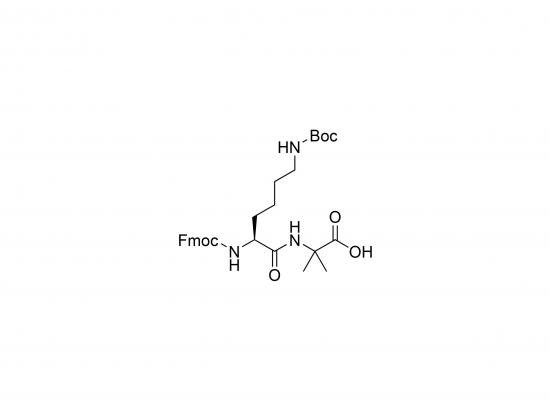
Fmoc-Lys(Boc)-Aib-OH is a protected dipeptide building block designed for solid-phase peptide synthesis (SPPS). It contains lysine (Lys) with its ε-amino group protected by a Boc (tert-butyloxycarbonyl) group and is linked to α-aminoisobutyric acid (Aib), which induces helical conformations such as α-helix and 3₁₀-helix. The Fmoc (9-fluorenylmethoxycarbonyl) group provides N-terminal protection, allowing controlled deprotection and coupling during synthesis. The Boc group prevents unwanted side reactions and enables further modification. The inclusion of Aib increases structural rigidity and peptide stability. This building block is widely used for synthesizing peptides with controlled structure and function, such as cell-penetrating, antimicrobial, and biomaterial-related peptides.
Appearance
-
White to off-white solid powder
Source
-
Synthetic chemical production
-
Commercially available from peptide synthesis reagent suppliers
Molecular Weight and Structure
-
Approx. 524.6 g/mol (C₂₉H₃₇N₃O₇; may vary if hydrated or as a salt)
-
Key Features:
-
Fmoc group at N-terminus
-
Lysine (Lys), with Boc-protected ε-amino group
-
α-Aminoisobutyric acid (Aib) residue
-
Free carboxyl group at C-terminus
-
Biological Activity
-
Biologically inactive as a standalone dipeptide
-
Activity emerges when part of larger peptide sequences
-
Aib promotes helical structure, increasing peptide stability
-
Boc deprotection yields positive charge from lysine, enabling interaction with membranes or biomolecules
Purity and Microbial Contamination
| Test | Specification |
|---|---|
| Purity (HPLC) | Typically ≥ 95% |
| Microbial contamination | Minimal; supplier COA should provide testing details |
| Endotoxin/sterility tests | Bacterial endotoxin (LAL) test, sterility testing |
Identity and Quality Control
| Test | Specification |
|---|---|
| Mass Spectrometry | Confirms molecular weight |
| NMR Spectroscopy (¹H, ¹³C) | Confirms chemical structure |
| IR Spectroscopy | Identifies key functional groups |
| HPLC | Determines purity and impurity profile |
| Optical Rotation | Confirms Lys stereochemistry |
| Amino Acid Analysis | Confirms amino acid composition after hydrolysis |
Shelf Life and Storage
| Feature | Description |
|---|---|
| Shelf Life | Typically 1–2 years if stored properly; check supplier COA for details |
| Storage | Store at –20°C or below, inert atmosphere (argon/nitrogen), sealed container, protected from moisture and light; avoid repeated freeze-thaw cycles |
Application
-
SPPS building block for α- and 3₁₀-helical peptides
-
Synthesis of cationic peptides for cell penetration or antimicrobial activity
-
Peptidomimetic design and protein interaction studies
-
Drug delivery (especially molecules needing cell penetration or interaction with negative surfaces)
-
Biomaterial engineering for specific charge and structural properties
Key Characteristics
-
Fmoc protection allows easy base-labile N-terminal deprotection
-
Boc is acid-labile and protects lysine side chain for selective post-synthetic modification
-
Aib confers conformational rigidity and helical structure
-
Lysine allows functionalization and charge modulation
-
Soluble in DMF, DMSO, acetonitrile
Citation

Reviews
There are no reviews yet.