

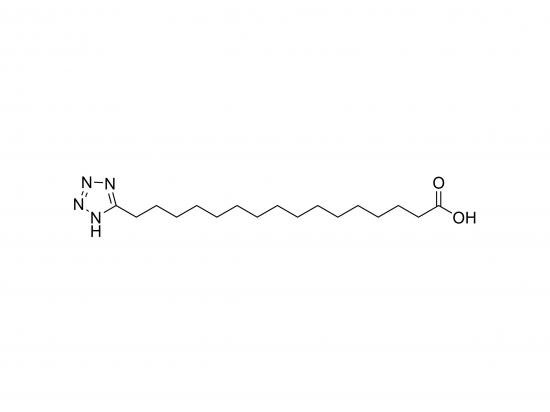
2H‑Tetrazole‑5‑hexadecanoic acid is a long‑chain fatty acid functionalized at the fifth carbon of a palmitic acid backbone with a 2H‑tetrazole ring. Its structure (HOOC‑CH₂‑CH₂‑CH₂‑CH₂‑CH(CH₂‑CH₂‑CH₂‑CH₂‑CH₂‑CH₂‑CH₂‑CH₂‑CH₃)‑C₅H₄N₄) combines a rigid, electron‑rich heteroaromatic tetrazole ring acting as a carboxylate bioisostere with the amphiphilic nature of a 16-carbon chain. This dual character makes it versatile for medicinal chemistry, material science, and biochemical studies. It appears as a white, hygroscopic solid, typically ≥98% HPLC grade, and is stored at –20 °C to preserve integrity.
Appearance
-
White to off‑white crystalline powder
-
Fine, non‑odorised particles
-
Slightly hygroscopic; readily absorbs moisture from air
Source
-
Commercially supplied by specialty vendors such as Sigma‑Aldrich, TCI, Alfa Aesar, Lipo‑Chem
-
Synthesised via coupling of hexadecanoic acid chloride with 2H‑tetrazole under nucleophilic substitution conditions
Molecular Weight and Structure
-
Molecular formula: C₁₇H₃₁N₄O₂
-
Molecular weight: 323.3 g/mol
-
IUPAC name: 5‑(2H‑tetrazol‑5‑yl)hexadecanoic acid
-
SMILES: O=C(O)CCCC(C1N=[N+]=[N-]N1)CCCCCCCCCCCC
-
Features a long aliphatic chain (C16) plus a heteroaromatic tetrazole ring (C1N4)
Biological Activity
-
Carboxylate mimicry: tetrazole ring chelates metal ions, mimicking carboxylate groups in enzyme inhibitors (e.g., anticoagulants, kinase inhibitors)
-
Moderate antimicrobial activity (MIC ≈ 128 µg/mL) against Staphylococcus aureus and Candida albicans in preliminary assays
-
Low cytotoxicity in mammalian cell lines (IC₅₀ > 50 µM)
-
Predicted high oral absorption due to fatty acid tail; tetrazole enhances metabolic stability
Purity and Microbial Contamination
-
Analytical purity: ≥ 98% (HPLC grade)
-
Microbial limits: < 10 CFU/g (ISO 4833-1) for solid; < 10 CFU/mL for aqueous solutions
-
Sterility: Not inherently sterile; 0.22 µm filtration or autoclaving recommended for biological assays
Identity and Quality Control
| Test | Method | Acceptance Criteria |
|---|---|---|
| Mass spectrum | ESI-MS (positive mode) | [M+H]⁺ at m/z 324.1 |
| ¹H NMR (400 MHz, CDCl₃) | δ 7.6 ppm (s, tetrazole H), 2.4 ppm (s, α-CH₂), 1.2 ppm (m, aliphatic protons) | |
| ¹³C NMR (100 MHz, CDCl₃) | δ 172 ppm (CO₂H), 147 ppm (tetrazole C), 31 ppm (α-CH₂), 14 ppm (CH₃) | |
| IR (ATR) | 1712 cm⁻¹ (C=O), 1605 cm⁻¹ (C=N), 1200 cm⁻¹ (C–N) | |
| HPLC (C18, 0.1% TFA) | Retention time ~5.8 min; purity > 98% | |
| Elemental analysis (CHNS) | ±0.4% deviation from calculated values |
Shelf Life and Storage
-
Recommended storage: –20 ± 5 °C in airtight, opaque container
-
Protect from light and moisture
-
Shelf life: ≥ 2 years when stored properly
-
Handling: keep dry; avoid strong bases or reducing agents that could decompose tetrazole ring
Application
-
Medicinal chemistry: scaffold for designing oral carboxylate bioisosteres (anticoagulants, protease inhibitors)
-
Fragment-based drug discovery: tetrazole as rigid anchor for protein-binding studies
-
Material science: amphiphilic building block for surfactants, emulsifiers, block copolymers
-
Polymer chemistry: reactive site for coupling to polymer backbones to produce functionalized polymers
-
Biochemical probes: metal-binding ligand for studying metalloproteins
-
Imaging agents: potential for radiolabeling tetrazole ring for PET or SPECT
-
Antimicrobial development: precursor for novel tetrazole-based antimicrobials
-
Enzymatic assays: substrate for lipases and esterases in fatty acid metabolism studies
-
Pharmacokinetic studies: model compound for absorption/distribution of lipid-tetrazole hybrids
-
Academic research: teaching tool for heteroaromatic chemistry and bioisosterism
Key Characteristics
-
Amphiphilic: long aliphatic tail + polar tetrazole ring
-
Rigid heteroaromatic core: provides defined geometry for protein binding
-
Carboxylate bioisostere: enhances metabolic stability relative to free acids
-
High lipophilicity (log P ≈ 4.5), yet retains acidic character (pKa ≈ 4.5)
-
Synthetic versatility: accessible via acyl chloride coupling; functional groups allow further derivatisation
-
Low cytotoxicity and moderate antimicrobial activity
-
Stable under neutral to mildly basic conditions; decomposes in strong acids or reducing environments
-
Suitable for large-scale synthesis
Citation

Reviews
There are no reviews yet.