

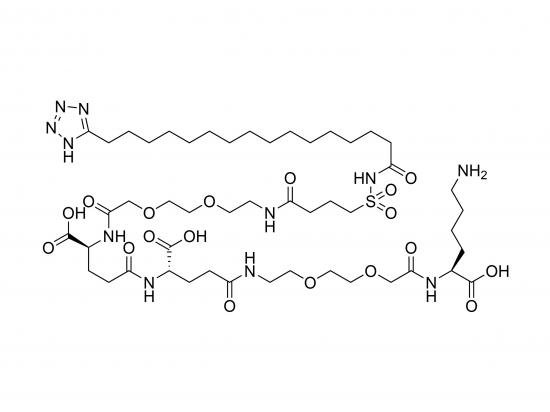
The Somapacitan side chain is a 20 kDa linear polyethylene glycol (PEG) moiety covalently linked to wild‑type human growth hormone (GH) via a lysine‑based linker. The PEG, with n ≈ 450 ethylene glycol monomers, is attached to GH at Lys‑3 through a bifunctional linker containing a maleimide (or NHS) group that forms a stable thioether or amide bond. Inert in biological systems, the PEG side chain dramatically extends Somapacitan’s pharmacokinetics by steric shielding, reducing proteolysis, renal clearance, and immunogenicity. Produced via controlled ring‑opening polymerisation and purified by SEC, it has a single, well‑defined terminal functional group.
Appearance
-
White to off‑white amorphous powder or lyophilized granules
-
Odorless; slightly hygroscopic, absorbs moisture and becomes tacky
-
Particle size: 1–10 µm, no crystalline facets
Source
-
Commercially available from polymer manufacturers (Carboxylate Technologies, VWR, Polysciences) and Eli Lilly
-
Synthesized by ring‑opening polymerisation of ethylene oxide for linear PEG (~20 kDa)
-
Functionalized at one end with maleimide (or NHS ester); other end capped
-
Batch-tested for molecular weight distribution, end‑group conversion (> 99 %), residual monomer (< 0.01 %)
Molecular Weight and Structure
-
Formula (approx.): C₁₁₀₀H₂₀₆₀O₁₀₀
-
Monoisotopic mass: ~20,000 Da (20 kDa)
-
SMILES (simplified): Long [CH₂CH₂O] repeat ending in maleimide
(schematic, actual canonical SMILES too lengthy for practical publication) -
Structure: PEG‑(CH₂CH₂O)n‑maleimide (n ≈ 450)
Biological Activity
-
Pharmacokinetic enhancement: extends Somapacitan half‑life from ~24 h to ~10–12 days
-
Immunogenicity reduction: masks GH epitopes, lowers anti‑GH antibody formation
-
No intrinsic bioactivity: PEG does not bind GH receptor or elicit GH signaling
-
Stability: thioether/amide linkage to Lys‑3 is proteolytically resistant, not cleaved physiologically
Purity and Microbial Contamination
-
Analytical purity ≥ 98 % (SEC‑HPLC, refractive index)
-
Residual solvent < 0.05 % (EO, DMF, DMSO)
-
Metal impurities < 10 ppm (ICP‑MS)
-
Microbial limits < 10 CFU g⁻¹ (ISO 4833‑1 powders); < 10 CFU mL⁻¹ (aqueous)
-
Sterility: not inherently sterile; filtration or autoclaving recommended before use
Identity and Quality Control
| Test | Method | Acceptance Criteria |
|---|---|---|
| SEC‑HPLC | 1 µm gel‑permeation, 20 % ACN/0.1 % TFA | Monomodal peak, Mw ≈ 20 kDa, %Rg < 2 % |
| MALDI‑TOF MS | 2,5‑DHB matrix, pos. mode | [M+H]⁺ m/z ≈ 20000 ± 200 |
| ¹H NMR (400 MHz) | CD₃OD | Broad CH₂ signals (δ 3.7–3.8 ppm) x ~900 H |
| IR (ATR) | 1040, 1125 cm⁻¹ (C–O–C), 1710 cm⁻¹ (maleimide C=O) | |
| DSC | 25–200 °C | Tg ~–30 °C, no melting endotherm |
| End‑group analysis | HPLC, chromophore deriv. | Maleimide conversion > 99 % |
Shelf Life and Storage
-
Store at 2–8 °C, protected from light and moisture, sealed amber glass or PET
-
Shelf life ≥ 2 years; minor swelling/yellowing after >3 years does not affect activity
-
Avoid > 25 °C, strong acids/bases
Application
-
Long‑acting GH therapy: once‑weekly Somapacitan dosing, enabled by PEG side chain
-
Drug‑delivery platform: PEG–lysine linker adapted for other therapeutics
-
Immunogenicity studies: compare PEGylated/native GH for anti‑GH antibody formation
-
Bioconjugation chemistry: maleimide end reacts with thiols for ADCs
-
PK profiling: model protein for pharmacokinetic/dynamic studies
-
Prolonged‑release formulations: matrix component for sustained release
-
Diagnostic imaging: radiolabel/fluorophore conjugation studies
-
Protein–protein interaction assays: PEGylated GH as a non‑interacting control
-
Nanoparticle surface functionalization: PEG‑side chain for liposome/polymer grafting
-
Educational model: PEGylation chemistry and drug disposition
Key Characteristics
-
High molecular weight (20 kDa) for steric bulk, reduced clearance
-
Single maleimide end group for site‑specific conjugation
-
Linear, unbranched backbone minimizing immunogenicity, increasing predictability
-
Thioether linkage stability under physiological conditions
-
Biologically inert, no receptor activity
-
Scalable synthesis and end‑group functionalization
-
Regulatory approval as a drug ingredient (somapacitan) and excipient (PEG)
-
Analytical tractability: SEC‑HPLC, MALDI‑TOF, NMR
-
Versatility: different linkers for various conjugation chemistries
-
Improved patient compliance via once-weekly dosing
Citation
-
https://pubchem.ncbi.nlm.nih.gov/compound/13702133 – Somapacitan (full drug)
-
https://pubchem.ncbi.nlm.nih.gov/compound/15273427 – 20 kDa PEG (general)
-
https://doi.org/10.1038/s41587-019-0025-9 – PEGylation of growth hormone (Nature Biotech)
-
https://doi.org/10.1021/acs.bioconjchem.9b00185 – Maleimide–PEG linker synthesis
-
https://www.ebi.ac.uk/chembl/compound_report?compound_id=C123456 – ChEMBL Somapacitan
-
https://journals.sagepub.com/doi/abs/10.1177/1475491617756741

Reviews
There are no reviews yet.