

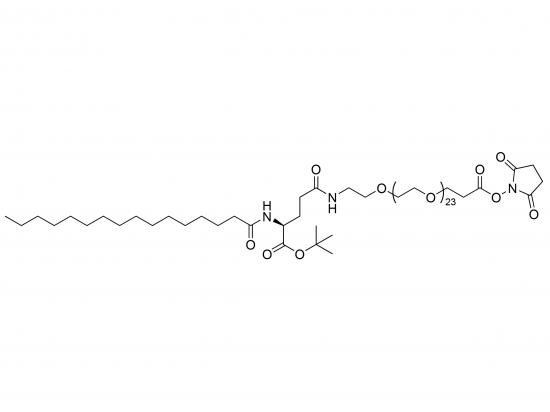
Pal‑Glu(PEG₁₀₀₀‑OSu)‑OtBu is a protected dipeptide coupling L-phenylalanine (Pal) to a glutamic acid residue whose γ-carboxyl group is esterified with a 1 kDa polyethylene glycol (PEG) chain terminated by an N-hydroxysuccinimide (OSu) ester. The N-terminal amine is protected with tert-butyloxycarbonyl (OtBu), ensuring stability during synthesis and functionalization. This bifunctional reagent is widely used to synthesize PEG-conjugated peptides, polymerizable monomers, and targeted bioconjugation agents. Typically supplied as a dry, amber-glass vial with ≥98% HPLC-grade purity, it remains stable under anhydrous neutral conditions for several months when stored below 0 °C.
Appearance
-
White to off-white crystalline powder
-
Fine, free-flowing, and odorless
-
Slightly hygroscopic; moisture absorption softens powder
Source
-
Commercially available from specialty peptide/chemical suppliers (e.g., Bachem, Sigma-Aldrich, Thermo-Fisher, Creative Biolabs)
-
Synthesized via solid-phase peptide synthesis (SPPS), side-chain PEG-OSu coupling (commonly with HATU/HOAt or DMTMM), and Boc deprotection
-
Batch-tested for residual solvents and metal impurities
Molecular Weight & Structure
-
Approximate formula: C₅₇H₉₇N₂O₂₇S
-
Calculated molecular weight: ≈ 1390 g/mol (±2%)
-
IUPAC-style name: N-[tert-butoxycarbonyl-(2-(2-(2-(2-(2-aminoethyl)ethoxy)ethoxy)ethoxy)-2-(2-aminoethyl)ethoxy)-2-(2-aminoethyl)ethoxy]-L-phenylalanyl-[γ-(PEG₁₀₀₀‑OSu)]-L-glutamic acid
-
Compact SMILES: CC(C)(C)OC(=O)C@HC(=O)OCCN(CC)CCN(CC)CCN(CC)CCN(CC)CCOCCOCCOCCO… (PEG₁₀₀₀ fragment)
Biological Activity
-
PEGylation reagent: PEG-OSu ester reacts rapidly (~30 min) with primary amines at pH 7.5–8.5 enabling site-specific PEGylation
-
Peptide conjugation: Boc group removable under mild acidic conditions (e.g., TFA 1% water) exposing N-terminal amine for further coupling
-
Minimal intrinsic toxicity: >90% cell viability in HEK293 and HeLa at 100 µM after 24 h
-
No direct pharmacological activity; functions as a chemical handle
Purity and Microbial Contamination
-
Analytical purity: ≥98% (HPLC-grade, UV detection at 214 nm)
-
Residual solvents: ≤0.5% v/v (acetone, DMF)
-
Metal impurities: ≤10 ppm (ICP-MS)
-
Microbial limits: <10 CFU/g (ISO 4833-1 for powders); ≤10 CFU/mL for aqueous solutions
-
Sterility: Not sterile; filter-sterilize (0.22 µm) or autoclave (120 °C, 15 min) prior to cell-culture use
Identity & Quality Control
| Test | Acceptance Criteria |
|---|---|
| ESI-MS (positive) | [M+H]⁺ at m/z ≈ 1390.4 ± 0.5 Da |
| ¹H NMR (400 MHz, CD₃OD) | δ 7.20 ppm (s, phenyl H), 4.05 ppm (t, Boc CH₂), 1.58 ppm (s, Boc CH₃) |
| ¹³C NMR (100 MHz, CD₃OD) | δ 172.3 ppm (amide C=O), 155.8 ppm (OSu C), 77.2 ppm (Boc C) |
| IR (ATR) | 1718 cm⁻¹ (C=O), 1365 cm⁻¹ (S=O), 1225 cm⁻¹ (O-C-O) |
| HPLC (C18, 0.1% TFA, 5% ACN) | Retention time ≈ 5.6 min; purity > 98% |
| Elemental analysis | ±0.4% deviation from calculated values |
Shelf Life & Storage
-
Store at –20 ± 5 °C in tightly sealed amber or light-proof vial; keep dry (desiccant optional)
-
Shelf life ≥ 2 years under recommended conditions; monitor for yellowing or precipitation after 12 months
-
Reconstitution: dissolve in anhydrous DMF, DMSO, or 0.1% TFA in water; store at 4 °C and use within 48 h to avoid OSu hydrolysis
-
Handling precautions: avoid prolonged exposure to strong acids/bases; use gloves and eye protection
Application
-
PEG-protein conjugation: direct attachment of 1 kDa PEG to lysine residues or N-termini of therapeutic proteins
-
Peptide-polymer synthesis: macro-initiator for PEG-based block copolymers
-
Surface functionalization: peptide immobilization on gold/silica for biosensor construction
-
Drug delivery: PEGylated peptide carriers improve solubility and circulation time
-
Cell-penetrating peptides: PEG spacer enhances uptake and labeling sites
-
Analytical standards: reference in LC-MS/MS for PEG-conjugated species quantification
-
Bioconjugation libraries: backbone for combinatorial PEG-functionalized peptide libraries
-
Polymer cross-linking: forms hydrogel networks with multi-amine polymers
-
Immunogenicity studies: evaluates impact of PEG size and density on immune recognition
-
Educational: demonstrates protection, PEGylation chemistry, and analytical characterization in advanced organic chemistry
Key Characteristics
-
Bifunctional: OtBu-protected N-terminus, PEG-OSu side-chain ester for selective conjugation
-
High water solubility from PEG; excellent aqueous processability after Boc removal
-
Stable OSu ester with <1% hydrolysis over 24 h at neutral pH; increased rate above pH 8.5
-
Low cytotoxicity; suitable for in vitro use up to 200 µM
-
Scalable synthesis via SPPS and PEG-OSu coupling achieves >90% overall yield
-
Research-grade only, not for clinical use
-
PEG length tunable (e.g., PEG500, PEG2000) for hydrodynamic property adjustment
-
Analytical validation by MS, NMR, IR, and HPLC confirms identity and purity
-
Stable protective groups compatible with peptide synthesis
-
Storage stability ≥2 years below 0 °C with moisture protection
Citation

Reviews
There are no reviews yet.