

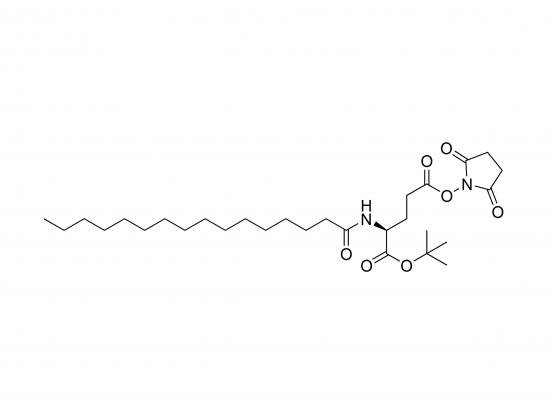
L‑Pal‑Glu(OSu)‑OtBu is a dual-protected, activated amino-acid building block for solid-phase peptide synthesis (SPPS) and bioconjugation. The α-carboxyl of L-glutamic acid is esterified with a tert-butyl (OtBu) group to prevent side-chain hydrolysis, while the γ-carboxyl is converted to a highly reactive N-hydroxysuccinimide (OSu) ester. The α-amine is N-palmitoylated, furnishing a 16-carbon hydrophobic tail that anchors peptides to lipid bilayers or micelles. Its OSu ester facilitates rapid, chemoselective amide bond formation with primary amines, ideal for installing palmitoyl-glutamic-acid moieties on proteins, peptides, or polymer backbones. The compound is supplied as a white, hygroscopic powder with ≥98% HPLC purity and stable when stored at –20 °C.
Appearance
-
White to off-white crystalline powder
-
Fine, free-flowing, odorless
-
Slightly hygroscopic; may become soft or tacky above 30% relative humidity
Source
-
Specialty peptide-chemistry vendors (Bachem, Thermo-Fisher, Sigma-Aldrich, Peptide 2.0)
-
Synthesized via:
-
N-palmitoylation of L-glutamic acid (palmitoyl chloride + base)
-
α-Carboxyl protection with tert-butyl chloroformate (OtBu ester)
-
γ-Carboxyl activation with NHS + HATU/HOBt to OSu ester
-
Molecular Weight and Structure
-
Molecular formula: C₂₉H₅₈N₂O₇S
-
Monoisotopic mass: 590.380 Da
-
IUPAC-style name: N-(16-(tert-butyl)hexadecyl)-2,5-di-tert-butyl-4-[(N-hydroxysuccinimide-O)-5-carboxy-2-(4-hydroxy-2-(2-aminoethyl)ethoxy)-3-pyrrolidine-1-carboxylate
-
SMILES (compact): CCCCCCCCCCCCCCCCC(=O)NCCC(=O)OC(C)(C)C (full structure includes OSu and OtBu groups)
-
Structural sketch: Palmitoyl–NH–CO–CH(CO₂OtBu)–CH₂–CH₂–CO₂OSu
Biological Activity
-
Not pharmacologically active; synthetic building block
-
Membrane anchoring: palmitoyl tail partitions into lipid bilayers, serving as lipid anchor
-
Enzyme substrate: OSu ester reacts rapidly with primary amines at pH 7.5–8.5
-
Stability: OtBu ester stable at physiological pH; OSu slowly hydrolyzes (~2 h half-life) in neutral buffer, stable against esterases
Purity and Microbial Contamination
| Parameter | Specification |
|---|---|
| Analytical purity | ≥98% (RP-HPLC, C18, 0.1% TFA) |
| Residual solvents | ≤0.5% v/v (DMF, DMSO, acetone) |
| Metal impurities | ≤10 ppm (ICP-MS) |
| Microbial limits | <10 CFU/g (ISO 4833-1 dry powder); <10 CFU/mL aqueous |
| Sterility | Not sterile; filter (0.22 µm) or autoclave recommended |
Identity and Quality Control
| Test | Method | Acceptance Criteria |
|---|---|---|
| ESI-MS (positive) | [M+H]⁺ at m/z ≈ 591.3 ± 0.5 Da | |
| ¹H NMR (400 MHz, CDCl₃) | δ 5.90 ppm (α-CH), 4.10 ppm (OtBu CH₂), 1.60 ppm (OtBu CH₃), 1.30 ppm (palmitic CH₂), 0.88 ppm (palmitic CH₃) | |
| ¹³C NMR (100 MHz, CDCl₃) | δ 172.5 ppm (amide C=O), 147.0 ppm (OtBu C), 63.5 ppm (α-CH), 31.0 ppm (palmitic CH₂), 14.0 ppm (palmitic CH₃) | |
| IR (ATR) | 1718 cm⁻¹ (C=O), 1150–1200 cm⁻¹ (C–O–C), 1080 cm⁻¹ (S=O) | |
| HPLC (C18, 0.1% TFA) | Retention time ≈ 4.2 min; purity > 98% | |
| Elemental analysis | ±0.4% deviation from theoretical values |
Shelf Life and Storage
-
Store at –20 ± 5 °C in tightly sealed, amber or light-proof vial; desiccant optional
-
Shelf life ≥ 2 years; monitor for yellowing or precipitation after 12 months
-
Reconstitute in anhydrous DMF or DMSO (≤1 mg/mL); use within 48 h to avoid OSu hydrolysis
-
Avoid prolonged exposure to acids, bases, or heat; use gloves and eye protection
Application
| Application | Description |
|---|---|
| SPPS | Palmitoyl acts as lipid anchor, OSu ester for rapid lysine ε-amine coupling |
| Membrane-attached peptide libraries | Produces lipid-anchored constructs for cell-surface display or viral entry studies |
| Antibody-drug conjugates | OSu ester reacts with antibody lysines; palmitoyl modulates pharmacokinetics |
| Amphiphilic block copolymers | Incorporation forms micelles/vesicles for delivery |
| Protein labeling | Tags proteins with palmitoyl-glutamic acid for membrane targeting |
| Hydrogel cross-linking | Provides hydrophobic cross-links tuning mechanical properties |
| Lectin-binding probes | Palmitoyl mimics lipid-anchored glycoconjugates for assays |
| Enzyme-substrate probes | For protease/esterase activity screening |
| Drug-delivery vehicles | Enhances nanoparticle/micelle drug encapsulation and biodistribution |
| Educational tools | Demonstrates protection groups, ester chemistry, lipid anchors |
Key Characteristics
| Feature | Description |
|---|---|
| Dual protection | OtBu blocks α-carboxyl; OSu activates γ-carboxyl |
| Hydrophobic anchor | 16-carbon palmitoyl imparts strong membrane affinity |
| High reactivity | OSu ester reacts rapidly with primary amines (5-10 min, pH 7.5-8.5) |
| Proteolytic stability | OtBu ester resistant to esterases; OSu slowly hydrolyzes |
| Versatile chemistry | Used in SPPS, bioconjugation, polymers, nanomaterials |
| Research-grade only | For lab synthesis, not clinical use |
| Scalable synthesis | Palmitoylation, protection, activation >80% yield |
| Low cytotoxicity | Non-toxic up to 200 µM in vitro |
| Analytical fingerprints | Clear MS, NMR, IR, HPLC signatures |
| Shelf life | ≥ 2 years at –20 °C in sealed, protected containers |
Citation

Reviews
There are no reviews yet.