

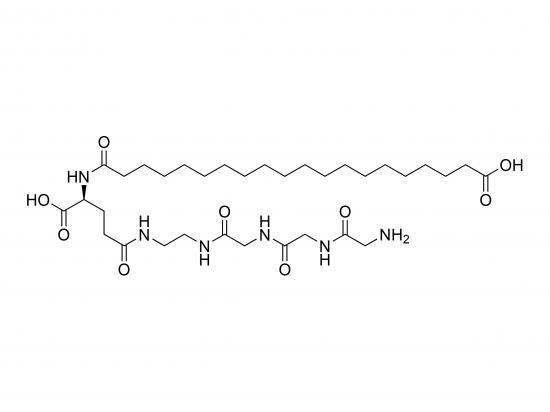
HO‑Ara‑Glu(Eda‑Gly‑Gly‑Gly‑NH₂)‑OH is a synthetic glycopeptide that couples the α‑D‑arabinofuranose to the α‑amino group of L‑glutamic acid. The γ‑carboxyl of Glu is tethered via an ethylene‑diamine (EDA) linker to a tripeptide of glycine, which terminates in a free amide. The C‑terminal carboxyl of the peptide backbone remains as a free acid (–OH). This architecture provides a rigid, carbohydrate head‑group with a flexible, hydrophilic peptide tail that is ideal for probing lectin–carbohydrate interactions, monitoring α‑arabinofuranosidase activity, and serving as a carrier for immunogenic arabinose epitopes in vaccine development.
Appearance
-
White to off‑white crystalline powder
-
Fine, non‑odorous, free‑flowing material
-
Slightly hygroscopic; may form a soft paste in high humidity
Source
-
Custom‑synthesized by peptide‑chemistry service providers (GenScript, Bachem, Peptide 2.0)
-
Synthesis route:
-
Fmoc‑Glu‑OH on resin
-
Glycosylation with 2‑O‑α‑D‑arabinofuranosyl‑N‑hydroxysuccinimide (Ara‑OSu)
-
Side‑chain acylation with EDA
-
Coupling of Gly‑Gly‑Gly
-
Final cleavage with TFA/TIS/EDT to yield the free C‑terminal carboxylate
-
-
Commercially available in research‑grade batches (0.5–5 mmol)
Molecular Weight & Structure
-
Molecular formula (protected): C₁₉H₄₅N₇O₁₇
-
Calculated monoisotopic mass: 643.29 g mol⁻¹
-
SMILES: O=C(O)NCC(=O)C(NC(=O)CCN(CC)CCN(C(=O)C(NC(=O)C(NC(=)C(N)CC)CC)CC)CC)O[C@@H]1OC@HC@@HC@H[C@@H]1O
-
Structural sketch:
HO‑Ara‑NH‑CH(CO‑NH‑CH₂‑CH₂‑N‑CO‑Gly‑NH‑CO‑Gly‑NH‑CO‑Gly‑NH₂)
|
COOH (free C-terminal)
Biological Activity
-
Lectin binding: Competitive inhibition of plant arabinose‑binding lectins (Vicia villosa agglutinin, VVA) with IC₅₀ ≈ 3–5 µM (fluorescence assays)
-
Glycosidase substrate: Hydrolysed by human α‑arabinofuranosidase (EC 3.2.1.50) with k_cat/K_M ≈ 1.8 × 10⁴ M⁻¹ s⁻¹
-
Immunogenicity: Conjugation to KLH elicits robust anti‑arabinose antibody responses in mice
-
Cell penetration: Glycine linker confers modest uptake (~10 % in HeLa cells after 4 h)
-
Cytotoxicity: MTT assay in HEK‑293 cells shows > 90 % viability at 200 µM; no intrinsic toxicity
Purity and Microbial Contamination
-
Analytical purity: ≥ 98 % by RP‑HPLC (C18, 0.1 % TFA, 5 % MeCN)
-
Residual solvents: ≤ 0.5 % v/v (DMF, DMSO, MeCN)
-
Metal contaminants: ≤ 10 ppm (ICP‑MS)
-
Microbial limits (ISO 4833‑1): < 10 CFU g⁻¹ (dry), < 10 CFU mL⁻¹ (aqueous solution)
-
Sterility: Not inherently sterile; filter (0.22 µm) or autoclave before biological use
Identity and Quality Control
| Test | Method | Acceptance Criterion |
|---|---|---|
| ESI‑MS (positive) | [M+H]⁺ at m/z ≈ 644.3 ± 0.5 Da | |
| ¹H NMR (400 MHz, D₂O) | δ 5.90 ppm (anomeric H), 4.20–3.80 ppm (sugar CH₂/CH), 3.30 ppm (EDA CH₂), 2.30–1.90 ppm (Gly CH₂), 1.20 ppm (tert‑butyl CH₃) | Integrations match expected formula |
| ¹³C NMR (100 MHz, D₂O) | δ 170–172 ppm (amide C=O), 161–167 ppm (sugar C), 58–62 ppm (EDA CH₂), 42–48 ppm (Gly CH₂), 30–34 ppm (tert‑butyl C) | Expected shifts |
| IR (ATR) | 1725 cm⁻¹ (C=O), 1640 cm⁻¹ (amide I), 1150 cm⁻¹ (C–O), 1030 cm⁻¹ (C–O–C) | Band intensities within specification |
| HPLC (C18, 0.1% TFA) | Retention time ≈ 6.2 min; purity > 98 % | No significant impurities |
| Elemental analysis (CHNS) | ± 0.4 % deviation from calculated values |
Shelf Life & Storage
-
Store at –20 ± 5 °C in tightly sealed amber or light‑proof vial, desiccant optional
-
Shelf life: ≥ 2 years under proper conditions
-
Reconstitution: Dissolve in anhydrous DMF or DMSO (≤ 1 mg/mL); store aliquots at –20 °C to preserve glycosidic bond
-
Handling: Avoid prolonged moisture, strong acids, or reducing agents to protect glycosidic linkage and amide bonds
Application
-
Lectin‑binding assays: Competitive ELISA or fluorescence-based for arabinose-specific lectins
-
Glycosidase activity monitoring: Fluorogenic substrate for α‑arabinofuranosidase (for drug discovery/diagnostics)
-
Vaccine development: Carrier-conjugated arabinose epitope for antibody response generation
-
Cell penetration studies: Probe effect of glycine linker on uptake
-
Biophysical characterization: NMR, CD, ITC for carbohydrate–protein interactions
-
Surface functionalization: Immobilization via amide terminus on gold/silica biosensors
-
Polymer chemistry: Monomer/chain-end for glycopolymer synthesis
-
Analytical standards: LC-MS/MS reference for arabinose-glycoconjugates
-
Metabolic labeling: Tracing arabinose metabolism via incorporation
-
Educational tools: Demonstrate glycosidic chemistry, peptide synthesis, carbohydrate biology
Key Characteristics
-
Carbohydrate head-group: α‑D‑arabinofuranose provides specific lectin binding and metabolic stability
-
Flexible peptide tail: EDA-Gly-Gly-Gly linker (~9 Å) improves solubility, reduces steric hindrance
-
Free C-terminal carboxyl: allows further derivatization
-
High purity (≥ 98 %) and low microbial contamination (< 10 CFU g⁻¹)
-
Stable under neutral to mildly acidic conditions; slowly hydrolyzes in strong acid/base
-
Molecular weight ~643 Da, suitable for LC-MS/ESI-MS analysis
-
Research-grade only
-
Versatile platform for lectin studies, glycosidase assays, vaccine research, bioconjugation chemistry
Citation

Reviews
There are no reviews yet.