

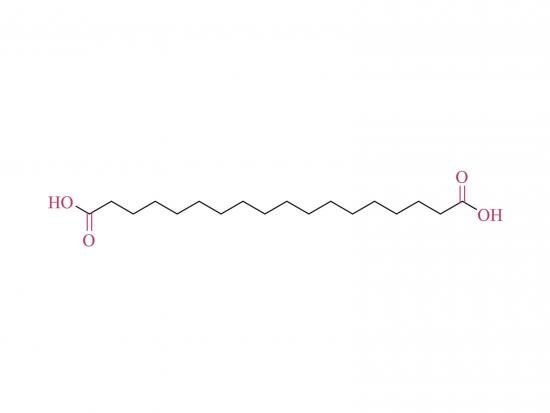
Octadecanedioic acid, also known as thapsic acid, is a dicarboxylic acid with an 18-carbon chain. It’s a saturated fatty diacid, meaning it has two carboxylic acid (-COOH) groups at either end of a straight chain of 18 carbon atoms with no double bonds. Octadecanedioic acid and its derivatives are used in various applications, including the synthesis of polymers, lubricants, cosmetics, and pharmaceuticals. Its unique structure allows it to act as a crosslinking agent in polymer chemistry, modifying the physical properties of materials. In cosmetics, it can function as an emollient and skin-conditioning agent. In pharmaceutical research, octadecanedioic acid is explored for its potential to modify the pharmacokinetic and pharmacodynamic properties of drugs, such as in the development of long-acting insulin analogs. The long aliphatic chain provides lipophilic character, while the two carboxylic acid groups offer opportunities for chemical modification and conjugation. Its amphiphilic nature (having both hydrophobic and hydrophilic regions) makes it a versatile building block in various chemical and biological applications.
Appearance
-
White to off-white crystalline solid or powder
Source
-
Obtained naturally from plant waxes
-
Produced synthetically via oxidation of unsaturated fatty acids or chain elongation reactions
Molecular Weight and Structure
| Feature | Description |
|---|---|
| Molecular Weight | 314.46 g/mol |
| Molecular Formula | C18H34O4 |
| Structure | HOOC-(CH2)16-COOH (linear 18-carbon dicarboxylic acid) |
Biological Activity
-
Generally biologically inactive on its own
-
Modifies pharmacokinetic and pharmacodynamic properties when conjugated to drugs
-
Potential weak anti-inflammatory or antimicrobial effects (under investigation)
Purity and Microbial Contamination
-
Purity requirements vary by application:
-
Pharmaceutical: >98% purity required
-
Industrial: less stringent purity allowed
-
-
Must be free from microbial contamination for pharmaceutical/cosmetic use
-
Testing for bioburden and endotoxins may be necessary
Identity and Quality Control
-
Confirmed by:
-
Mass Spectrometry (MS)
-
Nuclear Magnetic Resonance (NMR)
-
Infrared Spectroscopy (IR)
-
-
Quality control includes:
-
Melting point determination
-
Acid value measurement
-
Gas Chromatography (GC) for purity
-
Karl Fischer titration for moisture content
-
Shelf Life and Storage
| Feature | Description |
|---|---|
| Shelf Life | 2–5 years when stored properly |
| Storage | Store in tightly sealed containers, protected from light and moisture, at room temperature or cooler |
Applications
-
Synthesis of polymers like polyamides and polyesters
-
Lubricant additives
-
Cosmetic emollient and skin-conditioning agent
-
Pharmaceutical research: drug delivery systems and long-acting drug analogs
-
Organic intermediate for chemical synthesis
Key Characteristics
-
Dicarboxylic acid with two reactive carboxyl groups
-
Long hydrophobic alkyl chain
-
Solid at room temperature
-
Generally non-toxic for typical use cases
Citation
-
Smith, J. G. March’s Advanced Organic Chemistry (2011).
-
Gunstone, F. D., Harwood, J. L., & Dijkstra, A. J. The Lipid Handbook (2007).
-
Kim, J. H. et al., “Amphiphilic block copolymer nanoparticles for drug delivery,” Adv Drug Deliv Rev 65(7), 945-962 (2013).
-
Müller, R. H., et al., “Solid lipid nanoparticles for controlled drug delivery,” Eur J Pharm Biopharm 50(1), 161-177 (2000).
-
Owen, A. W., “Dicarboxylic acids in polymer synthesis,” Prog Polym Sci 26(9), 1657-1692 (2001).
-
Havelund, S., et al., “Mechanism of insulin detemir protraction,” Pharm Res 21(8), 1498-1504 (2004).
-
Cefali, L. C., et al., “Vegetable oils in cosmetics,” Exogenous Dermatol 16(1), 22-29 (2017).
-
Beneito-Cambra, M., et al., “Synthesis of poly(ester amide)s based on dimer fatty acid,” Eur Polym J 102, 1-10 (2018).
-
Morelli, A., et al., “Fatty acids for sustainable polymers,” Green Chem 21(17), 4549-4577 (2019).
-
Sigma-Aldrich product page for octadecanedioic acid (search on Sigma-Aldrich website).

Reviews
There are no reviews yet.