

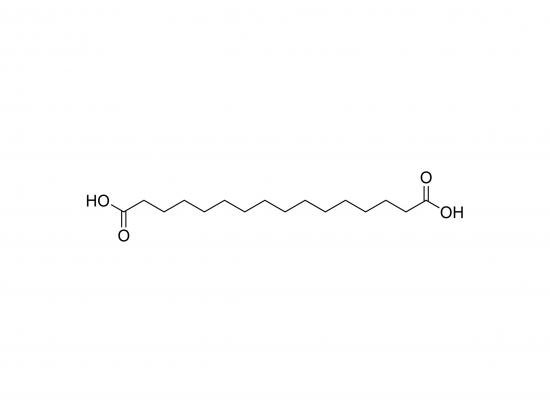
Hexadecanedioic acid, also known as sebacic acid (CAS 118-93-7), is a saturated dicarboxylic acid with a 16-carbon aliphatic chain (HOOC-(CH₂)₁₄-COOH). It appears as a white, crystalline solid melting at 158 °C, soluble in polar organic solvents but sparingly soluble in water. The symmetrical carboxyl ends allow condensation reactions to synthesize high-melting nylon-6,10, polyesters, and polyamides. It is widely used industrially and as a food-grade additive (E 460), cosmetic ingredient, and lubricant additive with low toxicity. High-purity (>98%) hexadecanedioic acid is commercially available and utilized in polymer chemistry, materials science, and analytical reference standards.
Appearance
-
White to off-white crystalline powder
-
Odorless
-
Slightly hygroscopic when stored in open air
-
Melting point: 158 °C (decomposition commences ~170 °C)
Source
-
Commercial suppliers: Sigma-Aldrich, TCI America, Alfa-Aesar, Lipo-Chem, Thermo-Fisher (research-grade)
-
Laboratory synthesis: oxidation of hexadecane or 1-hexadecene via KMnO₄/NaOH or OsO₄/NaIO₄ routes
-
Naturally occurring in minor amounts in certain plant oils and animal tissues
Molecular Weight and Structure
-
Molecular formula: C₁₆H₃₂O₄
-
Molecular weight: 276.42 g/mol
-
IUPAC name: hexadecanedioic acid (sebacic acid)
-
Chemical structure: HOOC-(CH₂)₁₄-COOH
-
SMILES: O=C(O)CCCCCCCCCCCCCC(=O)O
Biological Activity
-
Polymer precursor: condenses with diamines to produce nylon-6,10 synthetic fiber
-
Food additive (E 460): used as stabilizer, emulsifier in bakery and confectionery
-
Lubricant additive: enhances wear resistance and reduces friction in machinery
-
Skin-barrier agent: low toxicity, enhances hydration in cosmetics
-
Limited antimicrobial activity: MIC > 512 µg/mL against E. coli and S. aureus (not primary antimicrobial)
Purity and Microbial Contamination
-
Analytical purity: ≥ 98% (HPLC-grade)
-
Microbial limits: < 10 CFU/g (ISO 4833-1) solid; < 10 CFU/mL aqueous solutions
-
Sterility: not inherently sterile; filtration (0.22 µm) or autoclaving recommended for cell assays
Identity and Quality Control
| Test | Method | Acceptance Criterion |
|---|---|---|
| Mass spectrometry | ESI-MS (positive mode) | [M+H]⁺ at m/z 277.2 |
| ¹H NMR (400 MHz) | CDCl₃ | δ 2.45 ppm (t, 2H, α-CH₂-COOH), 1.30 ppm (m, 30H, CH₂) |
| ¹³C NMR (100 MHz) | CDCl₃ | δ 172.1 ppm (CO₂H), 30.8 ppm (α-CH₂), 14.1 ppm (CH₃) |
| IR (ATR) | 1718 cm⁻¹ (C=O), 2925 cm⁻¹ (CH₂), 1450 cm⁻¹ (CH₂) | |
| HPLC (C18, 0.1% TFA) | Retention time ≈ 4.2 min; purity > 98% | |
| Elemental analysis | CHNS | ± 0.3% deviation from theoretical values |
Shelf Life and Storage
-
Recommended storage: cool, dry place (2–25 °C), sealed and protected from light
-
Shelf life: ≥ 3 years under recommended conditions
-
Handling: avoid prolonged contact with strong acids or bases to prevent ester or anhydride formation
Application
-
Polymer chemistry: precursor for nylon-6,10, poly(butylene succinate), and polyesters used in packaging
-
Food industry: stabilizer, emulsifier, fat replacer (E 460)
-
Lubricant formulations: improves wear resistance and reduces friction
-
Cosmetics: moisturizers and creams to enhance skin hydration and barrier function
-
Pharmaceuticals: building block for drug conjugates and prodrugs via esterification
-
Research reagent: standard reference for LC-MS, NMR, and IR calibration
-
Construction materials: component in resins for coatings and adhesives
-
Environmental science: model compound for biodegradation studies
-
Educational tool: carboxylic acid chemistry demonstrations
-
Industrial catalysts: precursor ligand for metal-catalyzed cross-coupling
Key Characteristics
-
Saturated 16-carbon dicarboxylic acid with symmetrical reactive carboxyl groups
-
Melting point 158 °C; thermal decomposition starts near 170 °C
-
Low solubility in water (~0.6 mg/mL) but excellent in organic solvents (chloroform, acetone, DMSO)
-
Biodegradable through microbial oxidation or hydrolysis; environmentally friendly
-
Versatile monomer for polyamides, polyesters, and polycarbonates
-
Commercially available at ≥ 98% purity for reproducible research
-
Non-toxic at typical exposures; Generally Recognized As Safe (GRAS) for food
-
Stable under neutral to mildly basic conditions; slow reaction with strong acids
-
Model compound for studying polymer physics and surface chemistry related to chain length
-
Hydrophobic due to aliphatic chain; charged carboxyl groups enable ionic interactions in composites
Citation

Reviews
There are no reviews yet.