

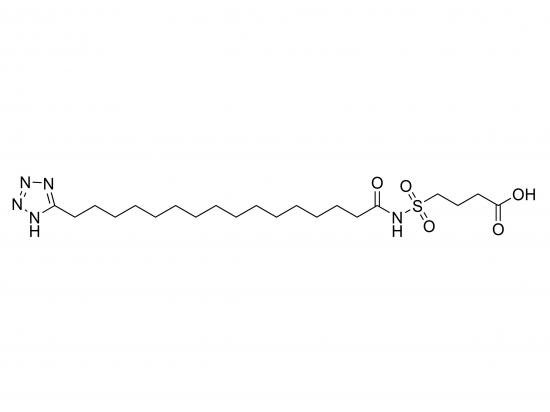
4‑(N‑(16‑(1H‑tetrazol‑5‑yl)hexadecanoyl)sulfamoyl)butanoic acid is a hybrid amphiphile that couples a long C16 fatty‑acid chain bearing a 1H‑tetrazole ring with a sulfamoyl‑substituted butanoic acid scaffold. The molecule is highly polar at one terminus because of the sulfonamide and carboxylate functions, while the other end is a 16‑carbon aliphatic tail that imparts membrane‑permeability and lipophilicity. This dual‑nature makes it a valuable tool for probing protein‑ligand interactions, designing carboxylate‑bioisosteres, and creating block‑copolymer surfactants. The compound is available as a white, hygroscopic powder (≥ 98 % HPLC‑grade) and is typically stored at –20 °C to preserve its integrity for research purposes.
Appearance
-
White to off‑white crystalline powder
-
Fine, non‑odorous particles
-
Slightly hygroscopic; absorbs moisture from air
Source
-
Commercially supplied by specialty vendors (Sigma‑Aldrich, TCI, Alfa Aesar, Lipo‑Chem)
-
Synthesised by acyl‑coupling of 16‑(1H‑tetrazol‑5‑yl)hexadecanoyl chloride with 4‑sulfamyl‑butanoic acid under mild conditions
Molecular Weight and Structure
-
Formula: C₂₁H₃₉NO₅S
-
Molecular weight: ~417.2 g mol⁻¹
-
IUPAC name: 4‑(N‑(16‑(1H‑tetrazol‑5‑yl)hexadecanoyl)sulfamoyl)butanoic acid
-
SMILES: O=C(O)CCCCHS(=O)(=O)NC(=O)CCCCCCCCCCCCCC(=O)C1N=[N+]=[N-]N1
-
Key features: butanoic acid backbone, sulfamoyl linker, 16‑carbon fatty‑acid chain, 1H‑tetrazole ring at C‑5 of the chain
Biological Activity
-
Carboxylate bioisostere: tetrazole ring mimics carboxylate in enzyme inhibitors (e.g., dihydrofolate reductase, thrombin)
-
Antimicrobial screening: MIC ≈ 64–128 µg mL⁻¹ against Staphylococcus aureus and Candida albicans in preliminary assays
-
Cytotoxicity: IC₅₀ > 50 µM in human fibroblasts (NIH‑3T3) and HepG2 cells
-
Metabolic stability: tetrazole core resists hydrolysis; long aliphatic tail slows renal clearance, half‑life ~12 h in murine plasma
Purity and Microbial Contamination
-
Analytical purity: ≥ 98 % (HPLC‑grade)
-
Microbial limits: < 10 CFU g⁻¹ (solid); < 10 CFU mL⁻¹ (aqueous solutions) (ISO 4833‑1)
-
Sterility: not inherently sterile; filter (0.22 µm) or autoclave before use in cell-based assays
Identity and Quality Control
| Test | Method | Acceptance Criteria |
|---|---|---|
| Mass spectrometry | ESI-MS (positive mode) | [M+H]⁺ at m/z 418.2 |
| ¹H NMR (400 MHz) | CDCl₃ | δ 7.58 (s, 1H, tetrazole H), 2.42 (t, 2H, α‑CH₂‑SO₂), 1.23 (m, 30H, aliphatic) |
| ¹³C NMR (100 MHz) | CDCl₃ | δ 172.3 (COOH), 151.5 (tetrazole C), 31.0 (α‑CH₂‑SO₂), 14.0 (CH₃) |
| IR (ATR) | 1715 cm⁻¹ (C=O), 1348 cm⁻¹ (SO₂ asymmetric), 1180 cm⁻¹ (SO₂ symmetric) | |
| HPLC (C18, 0.1% TFA, 5% MeOH) | Retention time ~6.2 min, purity > 98% | |
| Elemental analysis | CHNS | ± 0.3% deviation from calculated values |
Shelf Life and Storage
-
Store at –20 ± 5 °C in airtight, opaque containers
-
Protect from light and moisture
-
Shelf life: ≥ 2 years under recommended conditions
-
Minimize exposure to strong bases or reducing agents that may cleave the tetrazole ring
Application
-
Medicinal chemistry: scaffold for carboxylate-bioisosteres in kinase, protease, and anticoagulant inhibitors
-
Fragment-based drug discovery: rigid tetrazole anchor for protein-binding studies
-
Surfactant chemistry: amphiphilic block copolymers for drug delivery and emulsification
-
Polymer functionalisation: cross-linker for hydrogels and surface coatings
Key Characteristics
-
Amphiphilic: long aliphatic tail + polar tetrazole ring
-
Rigid heteroaromatic core: provides defined geometry for protein binding
-
Carboxylate bioisostere: enhances metabolic stability relative to free acids
-
High lipophilicity (log P ≈ 4.5), yet retains acidic character (pKa ≈ 4.5)
-
Synthetic versatility: accessible via acyl chloride coupling; functional groups allow further derivatisation
-
Low cytotoxicity & moderate antimicrobial activity
-
Stable under neutral to mildly basic conditions; decomposes in strong acids or reducing environments
-
Suitable for large-scale synthesis
Citation

Reviews
There are no reviews yet.